When designing wood shear walls with openings, LAVA supports the two commonly used analysis approaches recognized in practice.
Available Design Methods
There are two general methods for designing a shear wall with openings:
Perforated Shear Wall Method
Force Transfer Around Opening (FTAO) Method
LAVA can design shear walls using either method.
Perforated shear wall design requires specific detailing at the sole plate or sill plate and often more prescriptive boundary conditions. Because of these detailing implications, the FTAO method is typically preferred in practice for walls with significant openings.
Code Background
The building code does not prescribe a specific procedure for analyzing shear walls using the FTAO method. Instead, it allows a rational analysis.
Over time, two primary analytical approaches have become common:
1. SEAOC Method
Developed and published in the SEAOC Seismic Design Manual.
Mathematically rigorous
Often results in higher sheathing demands
May not be practical when window headers are very close to the top plate
Originally implemented in LAVA
2. Diekmann Method
Described in Design of Wood Structures (6th Edition) by Breyer.
Produces practical, reasonable results
Widely accepted in wood design practice
Currently used in LAVA
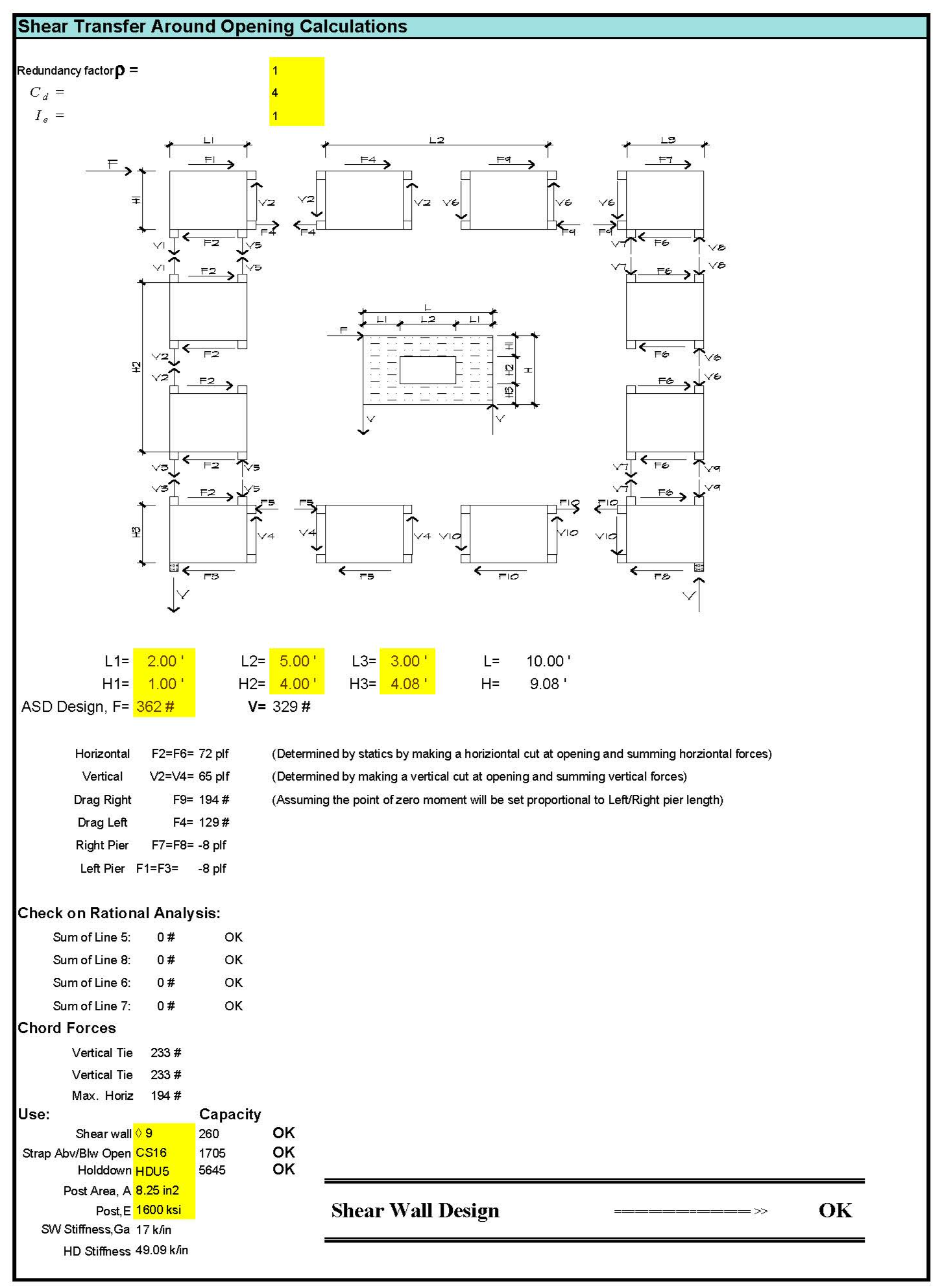
LAVA now uses the Diekmann method for FTAO analysis. Below is a sample calculation for the LAVA file attached.
How FTAO Works in LAVA
1. Baseline Example – Wall Without Opening
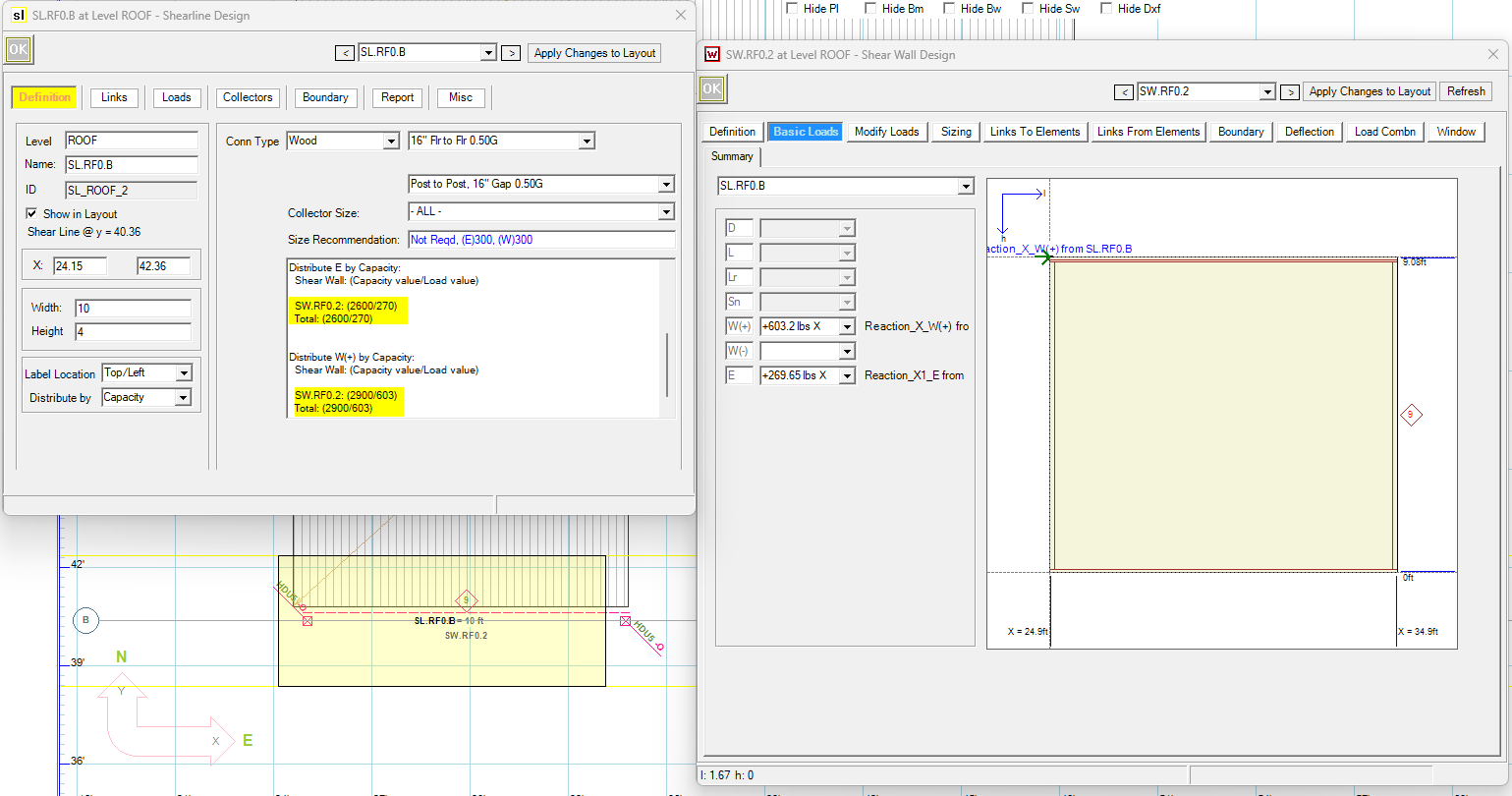
Consider a shear wall in a LAVA model with:
Wind load: 600 lbs
Seismic load: 270 lbs
The applied force is distributed directly from the Shear Line to this single shear wall:
2. Wall With Opening (FTAO)
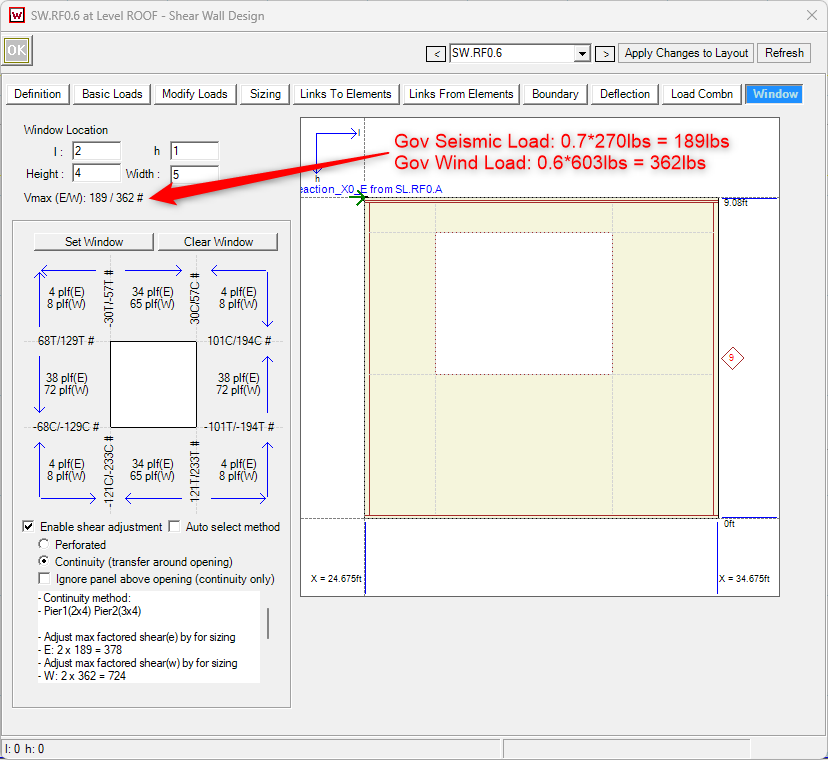
Now consider the same wall but with a window opening. After defining the opening in the wall, the loads are shown in the Window tab:
FTAO Amplification Factor
With FTAO:
Wall capacity does not change.
Demand load for SW sizing design changes
Because part of the wall length is removed by the opening, the remaining wall segments must carry higher shear stress.
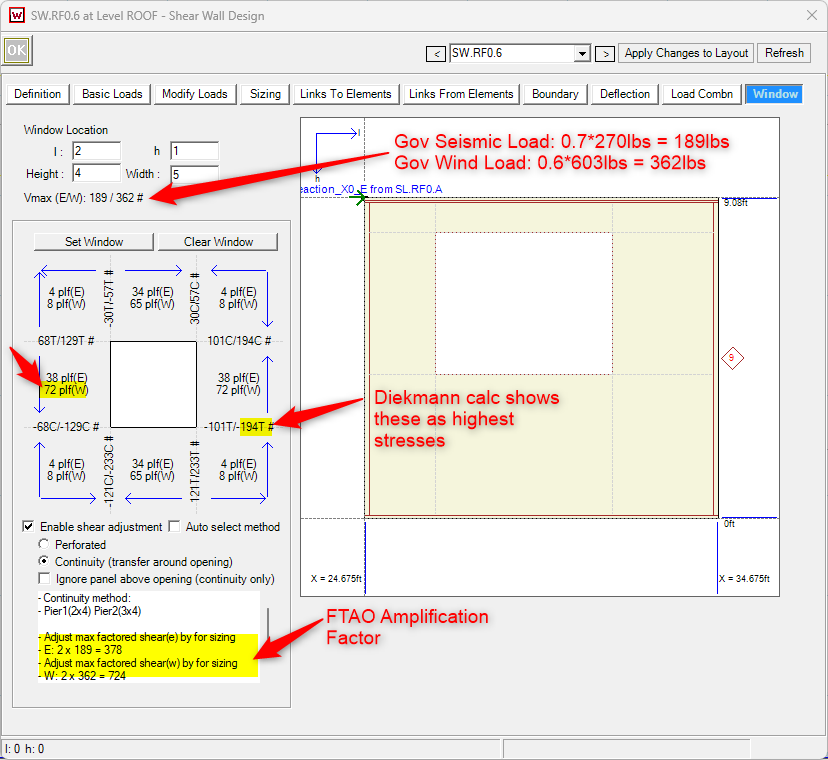
LAVA calculates an amplification factor to account for this redistribution. This factor increases the applied force used to size the remaining shear wall segments.
The factor used to amplify the applied shear force is:
Factor = (Maximum Shear Stress × Total Wall Length) / Applied Shear Force
Where:
Maximum Shear Stress = plf
Total Wall Length = ft
Applied Shear Force = lbs
Example Calculation
See LAVA file for reference with this example below.
Given: SW.RF0.6 at Roof Level
V (Wind) = 362 lbs
Length of Wall = 10 ft
Maximum shear stress = 72 plf
Factor = (72 plf × 10 ft) / 362 lbs
Factor = 2.0
LAVA reports this FTAO factor directly in the output.
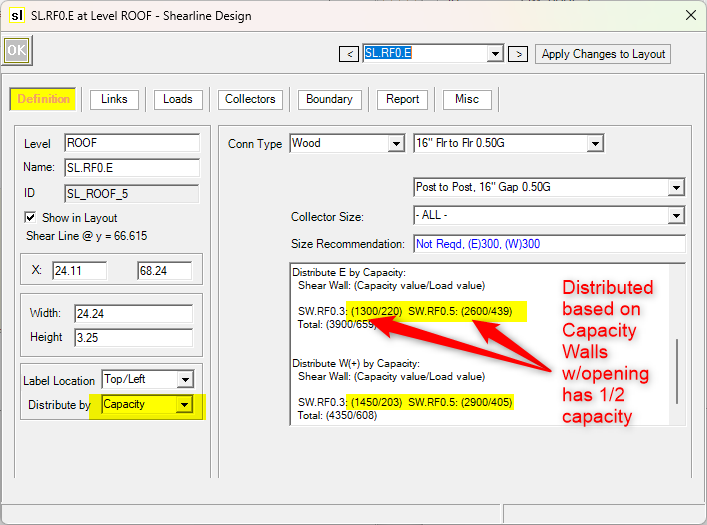
Load Distribution and Capacity Line Behavior
A key question is how this affects shear line distribution when comparing: A wall without an opening to a wall with opening
Note: The shear line distributes the applied load to the wall based on (see the full functionality here).
Wall capacity
Relative stiffness
Because the FTAO wall has an amplified demand factor:
The effective capacity per unit length is reduced relative to demand
The shear line distributes load based on adjusted stiffness and capacity
The wall with an opening will attract less load compared to a full wall
For example, if the amplification factor is 2.0:
The effective capacity behavior is reduced by half relative to a solid wall
The shear line may distribute approximately half the load to that wall compared to a similar wall without an opening
This allows an apples-to-apples comparison between walls with and without openings because both are evaluated consistently through the same shear line capacity framework.
Shear Line Behavior – Stiffness Method
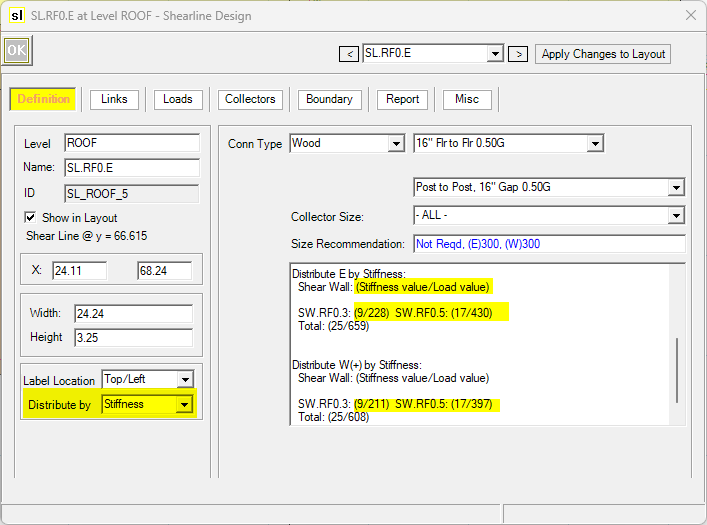
When the shear line distribution method is changed to Stiffness, the deflection along the shear line is forced to be the same for all connected wall segments. In other words, compatibility of deformation is enforced.
Because deflection is equalized, the load distribution is no longer based solely on capacity. Instead, the load is distributed according to the relative stiffness of each wall segment.
When FTAO is present, the effective stiffness of the wall segments is altered due to the amplification factor associated with the opening. As a result, once the stiffness method is selected:
Deflection is uniform along the shear line.
The redistributed loads change based on the modified stiffness values.
Walls with openings typically attract less load relative to solid walls, reflecting their reduced effective stiffness.
This allows the model to capture both compatibility and the stiffness reduction caused by openings in a rational and consistent way.
Summary
LAVA supports both Perforated and FTAO methods.
FTAO is typically preferred due to detailing flexibility.
LAVA uses the Diekmann method for FTAO analysis.
Wall capacity remains unchanged.
Demand is amplified based on opening size.
The amplification factor is clearly reported.